
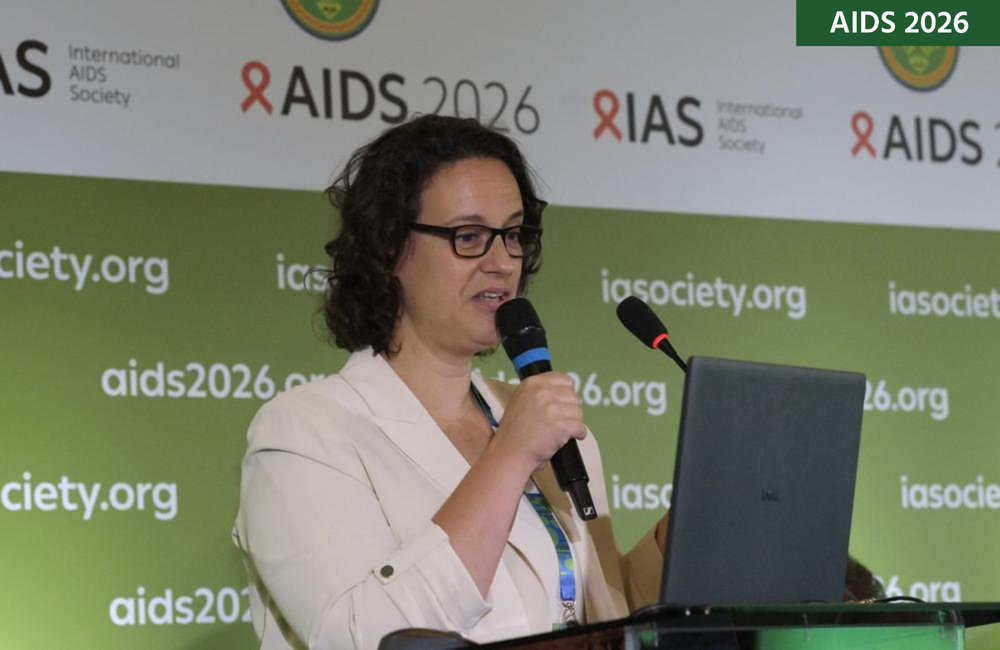
Starting treatment with a regimen containing doravirine and tenofovir disoproxil (TDF) resulted in less weight gain than starting treatment with a regimen containing dolutegravir and tenofovir alafenamide (TAF), a South African study reported this week at the 26th International AIDS Conference (AIDS 2026) in Rio de Janeiro, Brazil.
The available evidence suggests that weight gain can occur after starting antiretroviral treatment regardless of the drugs in the regimen. Studies consistently show that weight gain is greater in women and Black populations, especially when taking TAF in combination with an integrase inhibitor, such as dolutegravir or bictegravir.
Attempts to reverse weight gain by switching away from these drugs have been largely unsuccessful. However, prevention of significant weight gain when starting HIV treatment may be more achievable than reversal after weight gain is established.
South African researchers investigated whether starting treatment with a regimen that does not include TAF or an integrase inhibitor would result in equivalent levels of viral suppression but less weight gain.
The OptiDOR trial was carried out in South Africa. The study recruited 600 previously untreated adults without high-level resistance to doravirine, weighing more than 35kg. The study excluded pregnant or breastfeeding women, people with active tuberculosis and people with impaired kidney function or liver disease. Participants were randomised to one of two regimens. One included doravirine, TDF and lamivudine; the other was dolutegravir, TAF and emtricitabine.
The study population had a median age of 34 years and 69% were female.
The median CD4 count was 322 and over a quarter of participants had CD4 counts below 200, an indicator of advanced HIV. A low CD4 count at treatment initiation has been shown to increase the risk of weight gain.
The median weight among participants was 75kg and approximately one in three had a weight defined as clinically obese (>30kg/m2).
The primary study outcome was the proportion of participants in each study arm with a viral load below 50 copies/ml at week 48, with a non-inferiority margin of -10%. Virologic suppression in the doravirine / TDF / lamivudine arm was non-inferior to the dolutegravir / TAF / emtricitabine arm (89% vs 90.7%, difference -1.7%, 95% confidence interval -6.6% to 3.1%).
Fifteen participants experienced virologic failure during follow-up, defined as two consecutive viral load measurements above 1000 copies/ml from week 24 or two consecutive viral load measurements above 200 copies/ml at week 48.
Nine cases of virologic failure occurred in the doravirine arm and in seven of these cases, high-level resistance to doravirine emerged as a result of non-adherence. In six of the seven cases, virologic resuppression was achieved after switching to dolutegravir, TDF and lamivudine. One participant who developed high-level doravirine resistance was lost to follow-up. All of the cases of virologic failure in the doravirine arm occurred in people with advanced HIV and high viral loads (median CD4 count 34 cells, median viral load 4.9 log10 copies/ml).
None of the participants in the dolutegravir arm who experienced virologic failure developed resistance to any of the drugs in their regimen.
The secondary outcomes of the study were changes in weight and body composition measured by DEXA scan, as well as changes in lipids, bone mass and kidney function.
The doravirine-containing regimen was associated with significantly less weight gain at week 48 (-1.92kg, 95% CI – 2.78, -1.07, p<0.001) and fewer participants in the doravirine arm experienced weight gain of at least 5% of body weight (41.1% vs 56.8%).
There were modest but statistically significant differences in changes in total cholesterol, LDL cholesterol, triglycerides and total cholesterol:HDL cholesterol ratio favouring the doravirine arm.
Although significantly fewer in the doravirine arm experienced reductions in creatinine clearance of 25% or greater, the researchers noted a lack of difference in cystatin increases of greater than 25%, leading them to conclude that the difference in creatinine clearance was a consequence of greater inhibition of tubular secretion of creatinine by dolutegravir rather than genuine kidney damage.
There was no significant difference in changes in total bone mineral density between study arms but reductions in spinal bone mineral density were significantly greater in the doravirine arm (-3.2% vs -1.3%). No fractures were reported during follow-up.
One participant discontinued treatment due to a serious adverse event. Drug-related serious adverse events were uncommon (five in the dolutegravir arm and three in the doravirine arm).
Dr Joana Woods of Wits Ezintsha, University of the Witwatersrand highlighted the trade-offs between the two regimens: whereas dolutegravir-based treatment chiefly minimised the risk of drug resistance, doravirine-based treatment had a more favourable impact on weight and lipids. She concluded that doravirine / TDF / lamivudine is not a universal replacement for dolutegravir-based treatment, but offers a targeted first-line option where preventing obesity and cardiometabolic risk is a priority.
Woods J et al. Opti-DOR: 48 week data on DOR/3TC/TDF as an alternative first-line antiretroviral therapy (ART) regimen to integrase inhibitors for people with HIV and BMI>25kg/m2 in a randomised phase 3b non-inferiority study. 26th International AIDS Conference, Rio de Janeiro, abstract OAB3406LB, 2026.
View the abstract on the conference website.
Woods J et al. Initial HIV Therapy for Adults and Treatment-Associated Weight Gain: The Opti-DOR Randomized Clinical Trial. JAMA, online ahead of print, 31 July 2026.
doi: 10.1001/jama.2026.14762