
The United States is “changing the model, not the mission” of its global HIV programmes, Jeff Graham, acting US Global AIDS Coordinator, told a pre-conference session organised by the US government at the 26th International AIDS Conference (AIDS 2026) in Rio de Janeiro on 26 July.
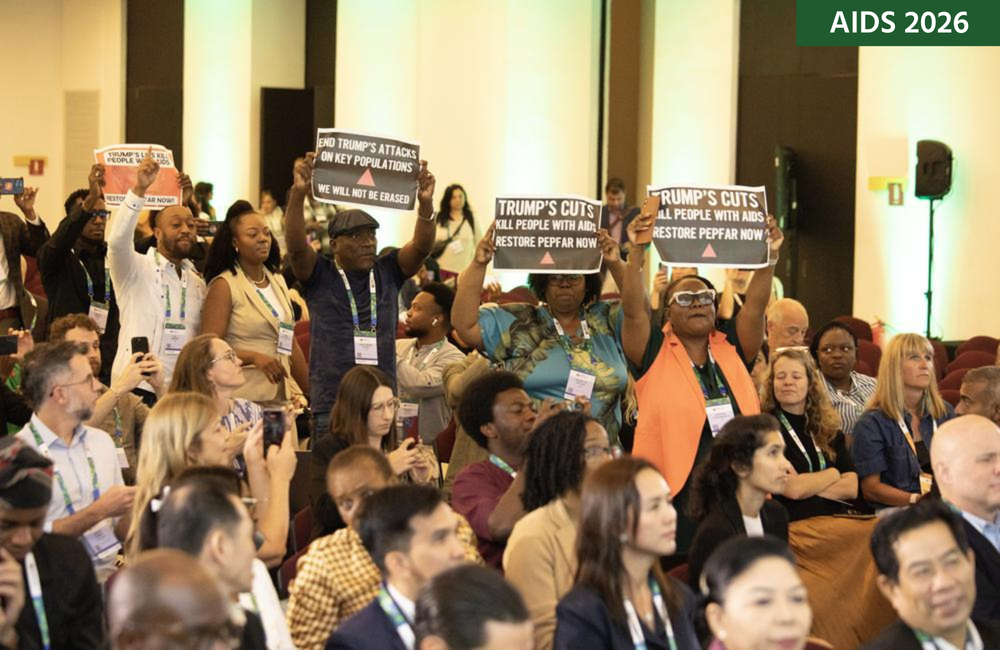
Minutes into his presentation, activists took the stage chanting “You lie, people die, restore PEPFAR now.”
“The last 16 months have been a public health emergency caused by your government's deadly disruptions in PEPFAR programming and global health aid, and we will not allow this fact to be erased,” Asia Russell, Executive Director of Health GAP, told Graham. “We will not allow our communities to be erased by your anti-science, anti-LGBTQ, anti-participation agenda.”
Graham did not respond directly to the protest and his presentation resumed once the activists left the stage. But an analysis presented in an abstract session on Wednesday found that it is not only the model that has changed, but the mission too.
“The approach of the administration is really transition first, meaning that they prioritise reduction of US assistance," Dr Jirair Ratevosian of the Duke Global Health Institute told delegates. “This is a big shift from what we've been accustomed to with PEPFAR, which has been more of sustaining HIV epidemic control, protecting treatment continuity, and the suppression of viral load. None of those terminologies or elements are part of the current approach.”
Ratevosian and colleagues reviewed 28 of the bilateral memoranda of understanding that now govern how the United States funds HIV, tuberculosis and malaria programmes in partner countries. Thirty-four have been signed since the first, with Kenya, in December 2025.
Under these agreements, the United States and a partner government sign a five-year plan setting out what American health funding will pay for, how it will decline over that period, and what the recipient government will contribute from its own budget. While most of the agreements have not been published publicly, Ratevosian managed to obtain the text of some of them and also drew on State Department press statements.
HIV remains the foundation of most of the agreements. Funding flows directly from government to government, bypassing many of the organisations and implementing partners that have traditionally delivered services in these countries. Most set out five-year goals, although some run for shorter periods. And across all of them, US financing declines over the life of the agreement.
That decline is the central concern. Planned US funding is approximately one third lower than in 2025, while governments signing them are expected to increase their own contributions as American support falls away.
While this may be achievable for some countries, Ratevosian said it would be far harder in countries like Ethiopia or Mozambique that are facing severe debt crises and other fiscal pressures.
"The concern is that the funding may fall before the domestic systems, the personnel, and the budgets at the country level can actually catch up," he said.
What is being cut
The bilateral agreements are providing a much narrower programme than PEPFAR previously did, Ratevosian's analysis showed.
Programmes that have been stopped, suspended or heavily cut include HIV prevention services for key populations, programmes for adolescent girls and young women, support for orphans and vulnerable children, voluntary medical male circumcision, services addressing gender-based violence, and harm reduction for people who use drugs. HIV testing and PrEP are still available but on a smaller scale.
In the pre-conference session, Graham had defended this, saying the previous system had rewarded spending rather than results.
"Success was often measured by how many dollars went out the door and into partners' hands, and not necessarily by how much actual care was being delivered," he said. “So today, we’re trying to focus on real outcomes, so fewer new infections, mature programmes that transition to local management where they're ready, and countries advancing toward that long-term self-reliance".
Who is left out
Ratevosian’s analysis also looked at what role the agreements give to faith-based organisations, civil society organisations and the private sector.
Nigeria is the only agreement reviewed that writes faith-based organisations into the programming template, with an earmark of 10%, worth approximately $208 million. But civil society organisations, key population-led organisations and others involved in service delivery are largely absent across the 28 agreements.
A survey of PEPFAR implementing partners presented at the conference found that terminations of US awards last year closed 1714 service sites, with locally based organisations the worst affected.
In Kenya, civil society organisations went to court over the bilateral agreement within a week of it being signed. The government signed on 4 December and by 10 December, Dr Patrick Amoth, Director General for Health, told the pre-conference session organisations had moved the High Court, which ruled that implementation could not continue. The government appealed, and implementation is now permitted while the case continues.
Amoth offered the episode as evidence that consultation had been thorough. "So civil society is part and parcel of this," he said, "and we look forward to work with them in terms of implementation of the cooperation framework."
Nigeria’s government also described existing relationships rather than a formal role in the agreements. The Director General of the National Agency for the Control of AIDS, Dr Temitope Ilori, said key populations had taken part in the negotiations and helped co-create the implementation plans. But she added that a few one-stop shop clinics serving key populations had closed because of the policy shift, with many of the services integrated into government hospitals and the private sector. She framed this as ending segregation, arguing that people should be able to walk into any facility and receive care regardless of sexual orientation or occupation. Criminalisation of homosexuality, sex work and drug use remains in force in Nigeria.
What happens next
How the agreements work in practice will only become clear as implementation begins.
"Ultimately, the success of this framework will not be measured simply by the amount of money invested," Amoth told the pre-conference session. "It will be measured by whether countries like Kenya emerge stronger, more self-reliant, and better able to protect the health of our people."
The United States remains the largest funder of the global HIV response. "I think we still fund something like 75% of the world's HIV response," Graham told the session.
That leaves countries without an agreement in a particularly vulnerable position.
Ratevosian noted that several are not being prioritised by the US administration, including Zimbabwe, Zambia and, most notably, South Africa, which has the world's largest HIV epidemic. There is real concern, he said, that US disengagement will lead to ongoing disruption.
Ratevosian J et al. Assessing transition readiness: a qualitative review of 28 U.S. global health MOUs and implications for HIV, TB, and malaria. 26th International AIDS Conference, Rio de Janeiro, abstract OAF1706LB, 2026.
View the abstract on the conference website.
Transforming health assistance: Implementing U.S. government bilateral MOUs for sustainable HIV programs - Operationalizing the America First Global Health Strategy: MOUs, implementation plans, and governance. 26th International AIDS Conference, Rio de Janeiro, pre-conference session PC06, 2026.
View the details of this sessions on the conference website.