
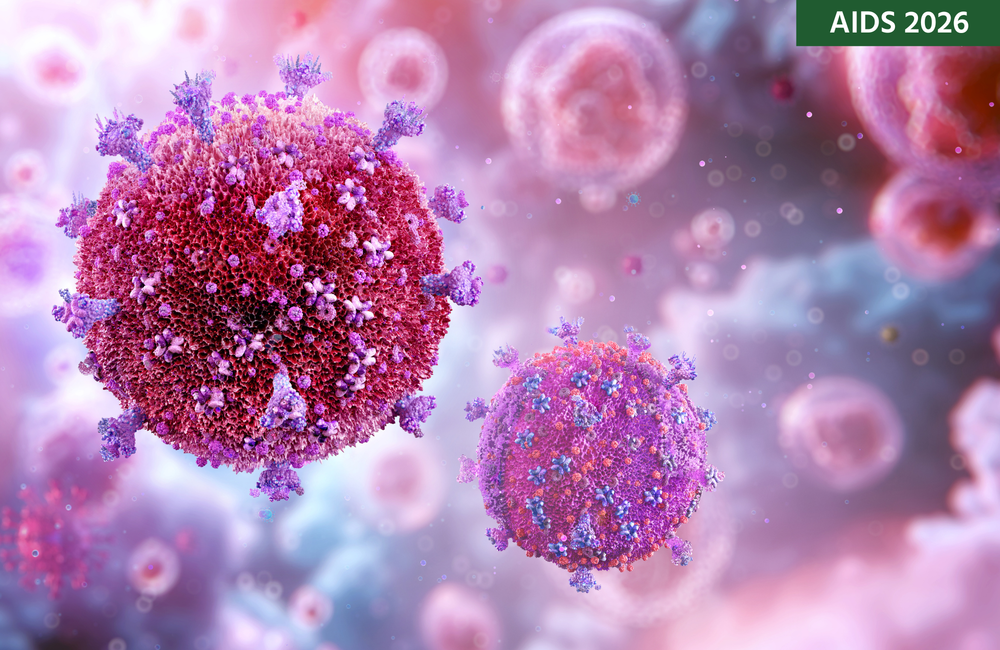
The 26th International AIDS Conference (AIDS 2026) in Rio de Janeiro last week heard about two more cases of HIV remission in people who had received stem cell transplants for leukaemia. These procedures had also cured their HIV, apparently by replacing all the cells in their body capable of producing HIV with non-infected cells.
Like most other stem-cell recipients in cure cases, they received cells from donors that happened to lack the CCR5 co-receptor. This cell-surface molecule is one of the two (the other being CD4) to which the HIV envelope ‘spikes’ must attach in order to infect these cells. It had been thought that using transplants from people lacking the CCR5 receptor was essential to prevent the recipient’s HIV from transiting into the new donor cells.
There have, however, been three cases where a cure has been achieved using cells from donors that do have CCR5. In one case, the ‘Geneva patient’, both sets of inherited stem cells (from their father and mother) had the CCR5 receptor. In a second, the ‘Second Berlin patient’, both donor and recipient were ‘heterozygous’ for CCR5: they had inherited a working copy of the CCR5 gene from one parent and a mutated, unusable copy from the other. Cells like these still produce CCR5, but less of it than usual — a partial deficiency that is known to confer slower progression to immune deficiency. Finally, the ‘New York patient’ received cells from two donors and only one of them lacked the CCR5 receptor.
This patient also had a second variety of HIV, common in long-term infection, that uses the CXCR4 co-receptor instead of CCR5 – so it can infect cells even when CCR5 is absent. This was also the case with the ‘Essen patient’, one of the two cures announced at AIDS 2026.
If it is not essential to use cells from CCR5-negative donors, this would be one step to making this form of cure more practicable (though it would still only be on offer to people who need stem-cell transplants, a risky and expensive procedure). The so-called delta-32 mutation, when inherited from both parents and so resulting in cells completely lacking CCR5, is only seen in 1% of people with northern European ancestry and almost no-one else.
It is still not completely understood, however, how uninfected donor cells come to replace recipient cells containing HIV. At AIDS 2026, researchers presented a possible method for blockading the CCR5 receptor on donor cells to give time for them to replace recipient cells without becoming infected themselves.
This blockade could be achieved by using a monoclonal antibody that attaches to the same part of the CCR5 as HIV does.
This monoclonal antibody is leronlimab (previously called PRO-140). It is fair to say that this molecule has had a chequered history: first developed two decades ago as a possible antiretroviral medication, it has been studied for use in various types of cancer and even in COVID, without gaining full clinical approval. Undeterred, its manufacturers CytoDyn are still investigating it in animal studies as a possible therapeutic vaccine for HIV, as well as a therapy for cancers.
Using leronlimab in stem-cell transplants
Professor Jonah Sacha of the Oregon Health and Science University told the conference that one possible use for leronlimab could be to act as a ‘shield’ to protect donor cells from becoming infected with HIV during the crucial period when they are ‘engrafting’ – replacing the recipient’s cells. Studies so far have only taken place in monkeys, but a study in humans needing stem-cell transplants is planned.
It has been assumed that the cures have worked because the donors’ CCR5-negative cells could not be infected. Sacha argued that the real driver is allogeneic immunity – the fact that during the process of engraftment, immune reactions that are as yet not completely understood lead to a deletion of the reservoir of cells that contain HIV. This is exciting news as it implies that similar immune reactions could be engineered in non-transplant recipients.
However, experiments in monkeys conducted by Sacha’s team also showed that there is a fine balance between HIV immunity and HIV infection, and that sometimes HIV can transfer to donor cells.
They showed this in a clever experiment where they conducted a sex-mismatched transplant in two monkeys. The donor was male and the recipient female. This meant that they could use the one unmatched chromosome male mammals have – the Y chromosome – as a marker for donor cells.
They found cells that must have come from the donor that were infected with SHIV (the monkey equivalent of HIV). This infection could not have arisen through the normal process of viral replication, as the recipient monkey was on fully suppressive ART – as was the donor monkey. So the virus must have transferred to the donor cells during the replacement of recipient with donor cells, at the time they were proliferating.
Sacha’s team had to show first that leronlimab has a general ability to stop infections before exploring a more specialised role in transplants. They showed that leronlimab protected monkeys from infection in a challenge experiment where six monkeys given leronlimab at a dose of 50 milligrams per kilogram stayed free of SHIV, and all six control animals became SHIV-positive after seven challenges.
The actual stem-cell transplant, of cells with CCR5, was given to a monkey named ‘Millie’. She started receiving leronlimab infusions two weeks before the transplant. Another thing the researchers did (which would probably not be possible in humans) was to give the donor animal a priming dose of Millie’s CD4 cells two weeks before the transplant so that they already had a degree of immune response to SHIV (this monkey was also on ART).
Initially, during the first three months or so post-transplant, 80% of Millie’s white blood cells were replaced by the donor’s but after a period of about 100 days she developed graft versus host disease, a potentially harmful but also potentially helpful condition in which the donor cells attack the remaining host cells.
Fifty-three days after the transplant, Millie had no detectable SHIV in her blood and after 121 days, none in her lymph nodes, spleen or digestive system. She also received a shot of a medication that temporarily disabled her CD8 cells. This should have resulted in a spike of SHIV in her blood, but there was none.
ART was finally withdrawn 450 days after her transplant, and so far, some 135 days later, there is no sign of SHIV reappearing.
Sacha mentioned that leronlimab has already been tried on a few individuals experimentally but now amfAR (the Foundation for AIDS Research) is sponsoring a trial called LATCH (Leronlimab in Allogeneic stem cell Transplant to Cure HIV) so that it can be given as an accessory therapy for anyone who needs a stem-cell transplant to cure leukaemia, and hopefully their HIV too. If results are positive, it may make searching for CCR5-negative stem cell donors redundant.
Sacha J et al. CCR5 Revisited: Emerging Insights into HIV Cure. 26th International AIDS Conference, Rio de Janeiro, symposium SY28, 2026.