
Early research studies in Africa that found higher education was associated with a greater risk of HIV have often been dismissed as errors or anomalies, especially once later research suggested the opposite pattern. But a recently published analysis in Social Science & Medicine suggests those early findings weren't wrong, but reflected a real change in the education-HIV relationship over time.
The researchers, Dr Ismael G. Muñoz and Professor David P. Baker, analysing data from over 300,000 people across eight African countries, show that for those born between 1960 and 1984, education was indeed associated with higher likelihood of having HIV, with this association peaking among people born in 1965 to 1969. But from the mid-1980s onward, this flipped: education became increasingly protective, and the protective effect strengthened with each younger generation.
The study
The researchers analysed Demographic and Health Survey (DHS) data from 304,630 adults across eight African countries: Lesotho, Zambia, Zimbabwe, Ethiopia, Malawi, Rwanda, Guinea and Senegal. The DHS provides nationally representative data, including the results of HIV testing offered to all women aged 15 to 49 in sampled households and a subsample of men.
Only respondents who completed HIV testing and provided full information on key variables were included. The key independent variable was education, measured as total years of full-time schooling, calculated from both the level and grade completed. Using years of education, rather than the highest level attained, allowed for comparisons across differing national education systems.
The analysis controlled for other factors associated with HIV risk, including urban or rural residence, marital status, and household wealth. Individuals were grouped into nine birth cohorts, each spanning five years (from 1955 to 1995).
To explore why the education-HIV gradient shifted over time, the study also examined differences by gender and by countries' HIV response. This included country-level data on HIV spending per capita, spending efficiency, and GDP per capita.
HIV prevalence rose from 9% among DHS respondents born in 1955 to 1959, peaked at 15% in the 1970 to 1979 cohorts, then declined to 6% among those born in the mid-1980s and fell to just 2% among those born in 1995 to 1999.
Gender differences in timing and magnitude
Among men born between 1955 and 1959, each additional year of schooling showed a small association with higher HIV risk, though not yet statistically significant. This pattern did not appear among women of the same cohort, who showed a null or slightly negative gradient.
The association strengthened sharply in the next cohort. Among men born 1960 to 1964, each year of education increased HIV risk by approximately 0.8 percentage points, the peak for men. For women, risk kept rising for another decade, peaking among those born 1970 to 1974 at approximately one percentage point per year of education, the highest gradient observed in the entire study. Women's gradient remained elevated and exceeded men's for two consecutive cohorts (1970-74 and 1975-79), suggesting HIV continued spreading through female networks even as men's risk began declining.
This delay likely reflected transmission networks. More educated men, particularly those who migrated to cities for work, had greater means and social freedom to engage in multiple concurrent partnerships, which were often seen as markers of status and success. They acquired HIV first, then transmitted it to female partners within overlapping sexual networks. These overlapping relationships created interconnected sexual networks through which HIV could spread rapidly, especially during the highly contagious early weeks of infection.
From the mid-1980s onward, the pattern flipped for both sexes. Women and men born between 1985 and 1989 showed a negative education-HIV gradient, meaning education had become protective. For those born in the 1990s, each additional year of schooling reduced HIV risk by approximately 0.5 percentage points. With average schooling levels of just over six years in these younger cohorts, this translated into about a 3% reduction in risk. By the 1995 to 1999 cohort, the protective effect was stronger among women than men.
These shifts occurred against a backdrop of rapidly expanding educational access. The oldest cohort (1955 to 1959) averaged only 3.5 years of schooling, and about 40% had no formal education, with most working as farmers or in low-skill urban jobs. Only 10% had any secondary education. By contrast, among the 1995 to 1999 cohort, just 10% had no schooling, 45% had completed some primary education, and over 40% had reached secondary level. Average schooling increased to 6.4 years.
The HIV response shaped the timeline
The timing of the education-HIV gradient shift varied according to countries' HIV response efforts.
In countries with higher spending on HIV and more efficient programmes (Lesotho, Zambia, Rwanda, and Zimbabwe), the shift happened a generation earlier. The association between education and increased HIV risk peaked among people born in 1960 to 1964, then began declining. By the 1980 to 1984 cohort, the gradient had reached neutral, and by 1985 to 1989, education had become clearly protective.
In contrast, in countries with lower spending on HIV (Malawi, Ethiopia, Senegal, and Guinea), the positive gradient peaked later, among those born in 1965 to 1969, and the protective shift was slower. These countries didn't reach neutral until around the 1985 to 1989 cohort, about five years later than the countries with greater investment.
This difference persisted in younger cohorts. Among people born in 1995 to 1999, each year of education reduced HIV risk by approximately 0.008 percentage points in better funded countries but only 0.002 percentage points in lower spending settings. The protective effect of education was four times stronger in countries with better-funded HIV responses.
Conclusion
The authors argue that education influences health through multiple pathways, not just knowledge, but also income, social status, and prestige. These don't always work in the same direction.
Early in the HIV epidemic, more educated men had greater means and social freedom to engage in behaviours that carried HIV risk. This occurred in an environment where accurate information about HIV transmission was scarce. Even educated individuals struggled to assess risk effectively without reliable information.
Over time, as public health campaigns improved and accurate prevention messages became widespread, the cognitive advantages that education provides (better ability to process information, assess risk, and adopt protective behaviours) began to dominate. Education shifted from amplifying risk to reducing it.
The authors note this pattern isn't unique to HIV. They describe it as a "Population Education Transition Curve," a temporal shift observed across multiple health risks as they emerge in populations. Similar reversals have been documented with tobacco, cocaine, and highly processed foods. In each case, more educated groups were early adopters, drawn by novelty, pleasure, or prestige. But once high-quality health information became available, they were also quicker to change behaviour.
Muñoz IG & Baker DP. Revisiting the education-HIV gradient in Africa: Cohort variation analysis of a temporal shift and speculation on causes. Social Science & Medicine 388: 118720, 2026 (open access).
https://doi.org/10.1016/j.socscimed.2025.11872
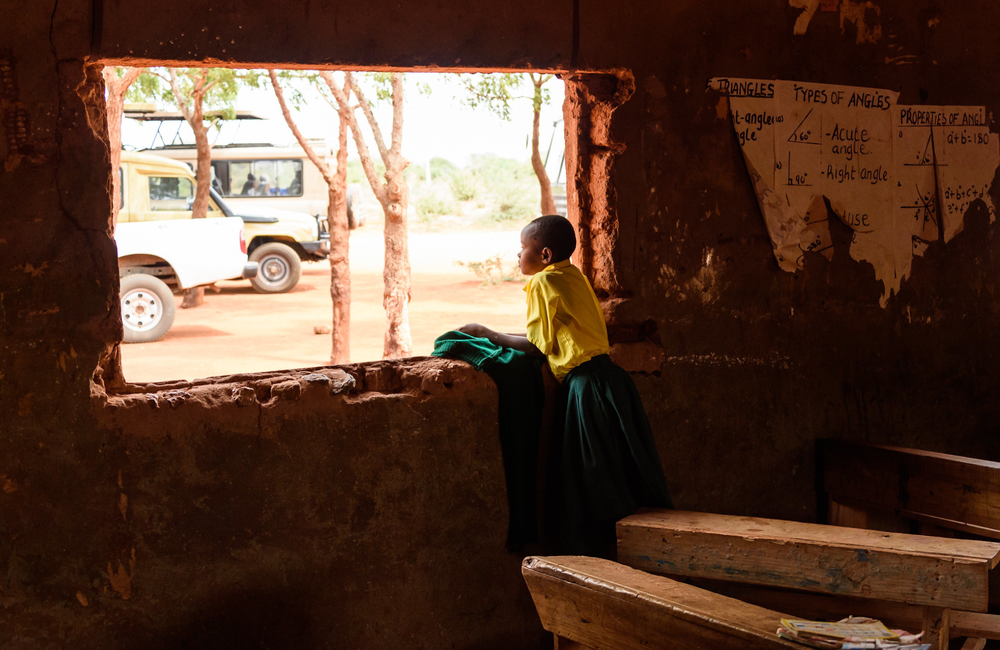
Full image credit: Watching the Celebration from the Classroom. Photo by Geoff Livingston. Image available on Flickr under a Creative Commons licence CC BY-NC-SA 2.0.