
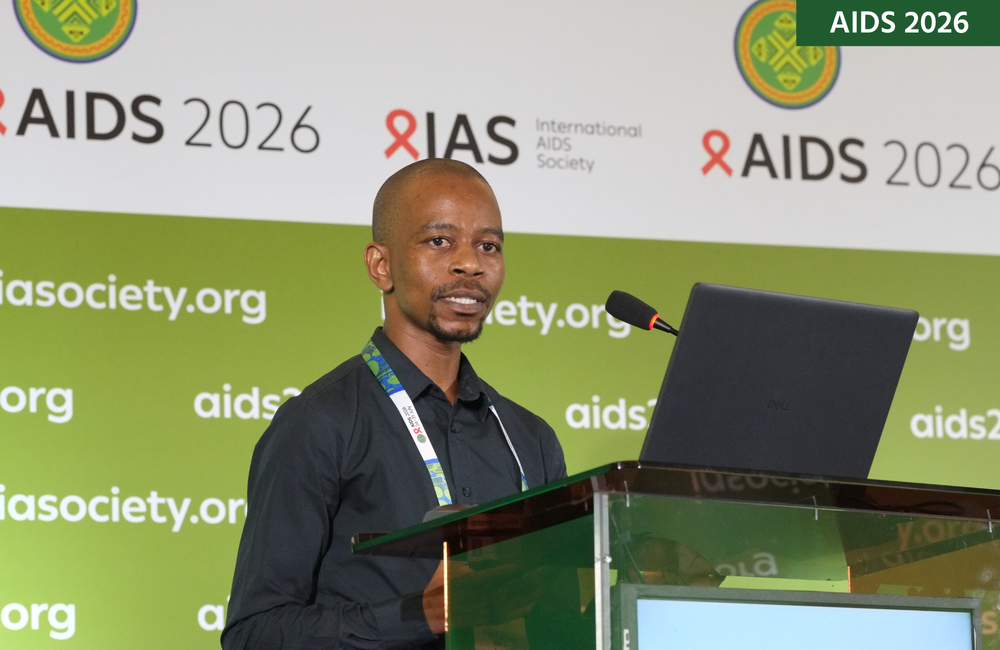
People with HIV in South Africa are ten times more likely to develop tuberculosis while interrupting treatment than while taking it, the 26th International AIDS Conference (AIDS 2026) in Rio de Janeiro heard last week. Even after resuming treatment and achieving viral suppression, their risk stayed 50% higher.
Using provincial health data from Western Cape, South Africa, Haroon Moolla from the University of Cape Town told the conference that of the almost 150,000 adults who started ART between 2017 and 2024, 60% had interrupted treatment at least once by the end of the study period. While interruptions made up only a fifth of the total follow-up time, they accounted for over half of all first TB episodes.
The team followed each person from HIV treatment initiation until their last recorded prescription, death, or first TB episode. The majority (68%) were women, and the median age at ART start was 32. Interruption was defined as having no medication in hand for 28 days or more.
Using people who remained virally suppressed on first-time ART as the comparison, the risk of TB during treatment interruption was 10 times higher for people whose baseline CD4 count had been 200 or above, and 13.5 times higher for those who started below 200. Each additional month off treatment added a further 2% risk of TB.
People who resumed treatment and achieved viral suppression still had a 54% higher risk of TB than those who had never interrupted. Those who resumed but remained unsuppressed were at more than nine times the risk.
"Healthcare workers need to be vigilant for TB, not only at the point of re-engaging, but also during subsequent follow-up," he said.
TB remains the leading cause of death among people with HIV worldwide, and the most common opportunistic infection in South Africa. A second South African study presented the same week examined how common advanced HIV disease is in the country's private sector and what it costs people who present with it.
Deaths and hospital admissions in the private sector
Sanele Mbeje of the Centre for the AIDS Programme of Research in South Africa (CAPRISA) presented data from Discovery Health Medical Scheme, which covers roughly 40% of private healthcare in the country. His team looked at over 16,000 people aged 15 and over who started ART between January 2018 and December 2024, following them to June 2025. Median age was 37 and 58% were women.
About 25% had advanced HIV disease when they started treatment, defined as a CD4 count below 200 or a WHO stage 3 or 4 condition. The study, however, could not distinguish between people starting ART for the first time and those who had previously received treatment because the medical scheme's records did not capture earlier ART use.
Over a median of almost four years, almost 500 people (3%) died. People who started treatment with advanced HIV disease were nearly five times more likely to die than those who did not. Deaths were concentrated in the advanced HIV disease group and mortality was higher in the first six months after starting treatment. The leading recorded cause of death in both groups was HIV-related but unspecified. Among those with advanced HIV disease, TB and other infections followed closely, while for those without, infections and cancers were equally common.
The hospital admissions trend was similar. Around a third of the cohort had a first admission over a median of 2 years, and people with advanced HIV disease were admitted at nearly twice the rate of those without it. The gap was widest in the first six months, when their admission rate was around three times higher. Lower respiratory tract infections led admissions among people with advanced HIV disease. In the group without it, the commonest reason for admission was depression.
Nearly half of the cohort, 45%, had no CD4 count recorded at ART initiation at all, and Mbeje noted that roughly half of those had in fact had a test done whose result never reached the dataset.
"CD4 count testing should be prioritised at ART initiation to ensure that we identify people with advanced HIV disease," he concluded. Interventions against TB and other infections in the first six months, he added, are likely to have the greatest effect on deaths and admissions.
Why is interruption driving advanced HIV disease?
In a different session, Professor Graeme Meintjes of the University of Cape Town and Queen Mary University of London showed delegates data from South Africa indicating that by 2025, 65% of people starting or restarting treatment with a CD4 count below 200 were returning to care after an interruption rather than beginning treatment for the first time.
Advanced HIV disease (AHD), which affects an estimated 1.9 million people in sub-Saharan Africa, is increasingly a condition of people whom the health system has previously found, treated and then lost.
One reason is that CD4 counts fall far faster than they recover. Treatment rebuilds them slowly over years, but when it stops they drop sharply: in the SMART trial, which tested planned treatment interruptions, counts dropped by around 200 in the four months after stopping. Recovery is also poorer each time someone restarts, so people who cycle in and out of care lose ground with every round. Interruption, Meintjes argued, is a key driver of advanced HIV disease.
Meintjes said the AHD package of care the sector has spent a decade refining reaches only those who present to clinics, and not the growing number of people who are out of care altogether.
He described three settings in which those people are encountered: those who are not in care at all, whether never diagnosed or disengaged; those entering or returning to care as outpatients; and those who are sick enough to be hospitalised. Each carries a different risk. Entering or re-entering care with a CD4 count below 200 carries about 12% mortality over the following year, rising steeply at lower counts. For those who need hospital admission, inpatient mortality is around 16%, with a further 14% dying in the year after discharge.
“What's important to point out is that the people who are not in care are not amenable to the interventions that we have developed for addressing advanced HIV disease,” Meintjes said. “The strategies for those not in care are improving our testing coverage, improving linkage retention strategies, and early return to care strategies. And then for those returning to care in outpatient settings, the AHD package care. And of course, for those who are hospitalised, improving hospital management and linkage after discharge to outpatient care.”
The tools for finding those who do present are also disappearing. While the 2026 World Health Organization's guideline update recommends CD4 testing as the preferred method for identifying advanced HIV disease, the tests themselves are leaving the market. Abbott halted production before committing to limited manufacture, BD Biosciences no longer produce the FACSPresto, and the main remaining option is the semi-quantitative VISITECT test. A landscape assessment by the Clinton Health Access Initiative found that CD4 testing across six southern African countries fell by 35% between 2024 and 2025. Coverage ranged from over 80% of people newly starting ART in one country to as little as 16% in another.
Screening for the infections that kill people with advanced HIV disease is patchier still. In one of the countries surveyed, just 3% of eligible clients received either cryptococcal antigen or TB LAM testing, and the best-performing country reached only around 50%.
Preventive treatment is also breaking down. Surveillance at Johannesburg hospitals through the Advanced GERMS study found that only 2% of people admitted with advanced HIV disease reported having taken co-trimoxazole prophylaxis in the previous year, and 3% TB preventive therapy.
In the REVIVE trial, which is testing an additional antibiotic across 11 African countries for people entering or returning to care with a CD4 count below 100, all participants were on ART. But co-trimoxazole, the antibiotic already recommended for everyone with advanced HIV disease, reached only 80% of them at the start and fell below 70% by six months.
"And this is in a clinical trial setting," Meintjes said. "It's probably even worse in routine care."
Moolla H et al. Tuberculosis Amidst the High Tide of Antiretroviral Therapy Interruptions: A Retrospective Cohort Study in South Africa. 26th International AIDS Conference, Rio de Janeiro, abstract OAB4102, 2026.
View the abstract on the conference website.
Mbeje S et al. Advanced HIV disease and subsequent mortality and hospitalization among people living with HIV in South Africa. 26th International AIDS Conference, Rio de Janeiro, abstract OAB2004, 2026.
View the abstract on the conference website.
Meintjes G. What we know vs what is happening. Unfinished business: ending preventable deaths from advanced HIV disease in a changing HIV response. 26th International AIDS Conference, Rio de Janeiro, SAT37, 2026.