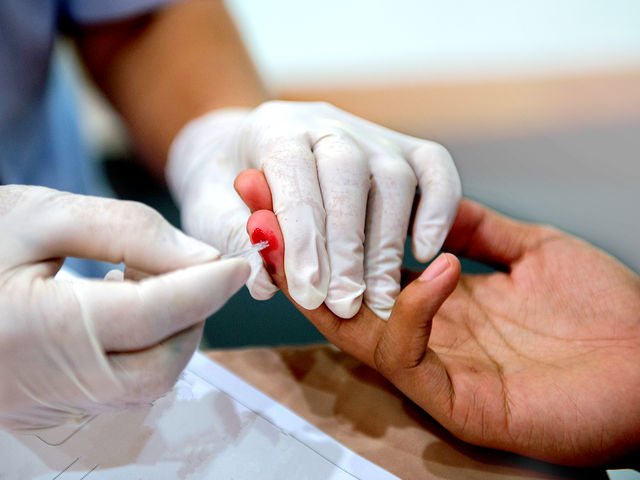
Self-sampling and self-testing are ways to get tested for HIV at home.
You don't need to see a doctor or nurse to use home-testing kits.
HIV tests licensed for use in the UK are extremely accurate.
HIV testing is usually provided by medical professionals in hospital clinics, GP surgeries and other settings. It may also be provided by trained staff from HIV and community health organisations. In addition, there are two different ways you can get tested for HIV at home:
Self-sampling: you collect your own sample, either of blood or of moisture from your mouth. You send this to a laboratory for analysis. They will make your results available by phone or text a few days later.
Self-testing: you collect a sample of blood or of moisture from your mouth. You perform the whole test yourself. After a few minutes, you read and interpret your own test result.
You don’t need to see a doctor or nurse, and you can use these kits wherever you want, including at home. For that reason, both approaches are often referred to as ‘home testing’. For clarity, this factsheet uses the terms ‘self-sampling’ and ‘self-testing’.
Self-sampling
In the UK, many sexual health clinics offer free self-sampling services, and they may also be available online through websites like freetesting.hiv. Commercial companies including Lloyds Pharmacy and Superdrug also offer self-sampling kits. Self-sampling has always been legal in the United Kingdom.
There are some differences but generally the services work as follows:
You order a self-sampling kit from the organisation’s website. You may be asked some questions to check you are eligible.
The kit is sent to your home in the post.
You collect your own sample. You may be given a tiny lancet (a pin) to prick your finger and produce a few drops of blood. Or you may be given a mouth-swab to collect moisture from your gums.
You return the sample to the laboratory, by post.
The laboratory contacts you by text or phone with the results. If the test shows you might have HIV, you will be contacted by phone to discuss the result and arrange confirmatory tests.
You might be able to send samples to test for sexually transmitted infections like chlamydia and gonorrhoea at the same time. For example, you’d need to take a swab from the urethra, vagina, cervix, throat and/or rectum. A blood sample can also be tested for syphilis. One advantage of self-sampling over self-testing is that you can be tested for more infections at the same time. There aren’t any self-tests for chlamydia or gonorrhoea.
Self-testing
Rev. Jide Macaulay talks about how easy it is to get tested for HIV and why testing is so important.
Self-testing is different from self-sampling in that you perform the whole test yourself and you get the result immediately.
It used to be illegal to sell or advertise HIV self-testing kits in the UK – HIV testing equipment could only be sold to medical professionals. These restrictions were lifted in April 2014. Testing kits designed to be used by members of the public can be sold as long as the kit carries a CE mark to show it meets European performance and safety requirements.
At present, three CE marked tests are available. The first two involves using a safety lancet to produce a drop of blood from a finger and applying the blood to the test device. The tests’ names are the INSTI HIV Self Test and the Newfoundland HIV Test. The result can be read instantly (INSTI) or after 15 minutes (Newfoundland). Studies suggest that the tests are very accurate, except for cases of recent infection.
The third test is the OraQuick In-Home HIV Test. This needs a sample of moisture from the mouth and gives results in 20 minutes. It isn’t quite as reliable as the tests used by medical professionals – in a study it gave an accurate result to 93% of people who had HIV and 99.9% of people who did not have HIV.
The tests are sold for between £15 and £30 through the manufacturers’ websites: INSTI, Newfoundland and OraQuick, as well as from online pharmacies.
In addition, unregulated self-testing kits continue to be available from internet retailers. These kits may not meet European standards and may give inaccurate results. They may have been designed for use by medical professionals and be difficult for others to use correctly.
How reliable are these tests?
The HIV tests licensed for use in the UK are extremely accurate. Nonetheless, no medical test is perfect. For this reason, medical professionals never tell someone they have HIV on the basis of one test result – if the result suggests infection with HIV, it must be confirmed with two more tests, using a different type of test kit each time.
The same rules apply with self-sampling and self-testing.
If a test shows you might have HIV then you’ll need to take more tests to confirm the result. These extra tests are best done at a sexual health clinic, where they have access to the most accurate HIV testing technologies.
Clinic staff can also give you support and medical care.
If there are no signs of HIV (‘HIV negative’), you need to take into account the test’s ‘window period’. In general, tests are not able to detect HIV until a few weeks after it was caught. The window period varies; some of the difference depends on the type of sample.
Some self-sampling services ask you to collect a tiny tube of blood, which you send off to a laboratory. In this case, the window period is the same as for many HIV tests used by health professionals. The test is usually able to detect HIV that was caught four weeks (one month) ago. But occasionally it can take up to 12 weeks (three months).
The INSTI HIV Self Test has a similar window period. It will usually be able to detect HIV that was caught four weeks (one month) ago. But occasionally it can take up to 12 weeks (three months). The manufacturer of the Newfoundland HIV Test say that their window period is 12 weeks (three months).
If the sample is moisture from your mouth, the window period may be longer. It may also be a little longer if the sample is a drop of blood squeezed onto a piece of paper. In these cases, tests are frequently able to detect HIV that was caught between four and eight weeks ago. But it may take up to 12 weeks for infections to be detected. This applies both to self-sampling using these kinds of samples and the OraQuick self-test.
The information on window periods means that if you test less than 12 weeks after an activity which could have exposed you to HIV (like sex without a condom), then an HIV-negative result is not definitive. You can only be sure by testing 12 weeks after the last risky activity.
One specific situation in which self-tests are not reliable is when you are taking antiretroviral medications, either as HIV treatment, pre-exposure prophylaxis (PrEP) or post-exposure prophylaxis (PEP). For example, sometimes people have a doubt about their HIV diagnosis and use a self-test to check or reconfirm their HIV status. The results are sometimes inaccurate in these situations.
The vast majority of people are likely to receive accurate results when using self-sampling and self-testing. They are also convenient ways to test. However, if you have any concerns, you may prefer to test at a clinic, where they use the most advanced HIV testing technologies.
Choosing the right test for you
Many people prefer home testing because it’s quick, doesn’t require a trip to a clinic and may feel more private. The convenience of these services could help you to test regularly. Home-testing kits have been designed to be easy to use. Nonetheless, you need to follow the instructions carefully to get an accurate result.
Some people prefer to go to a clinic where they are tested by a medical professional and can also be tested for other sexually transmitted infections. Also, if the test result is unclear or might be positive, staff can give you advice and check the result with additional tests straightaway.
Before testing by yourself, it’s worth thinking about how you would cope if the test showed you might have HIV. It may be up to you to seek advice and support. This will be available from the service providing the test, local HIV organisations, sexual health clinics and HIV clinics. It would be very important to go to a clinic to have the test result checked.
HIV testing offered by NHS clinics and charities is free of charge. However, a service offered by a private company may cost around £40.
Roger Pebody
Commissioning Editor
Roger joined aidsmap in 2008 and was Managing Editor from 2018 to 2024. As a freelancer, he now edits aidsmap’s news and conference coverage, as well as working on updates to About HIV pages. He is also a contributing science editor for TheBodyPro, a freelance journalist for The Lancet HIV, and a medical writer helping researchers prepare articles for peer-reviewed journals. He began working on HIV at Gay Men Fighting AIDS in the mid-1990s.