
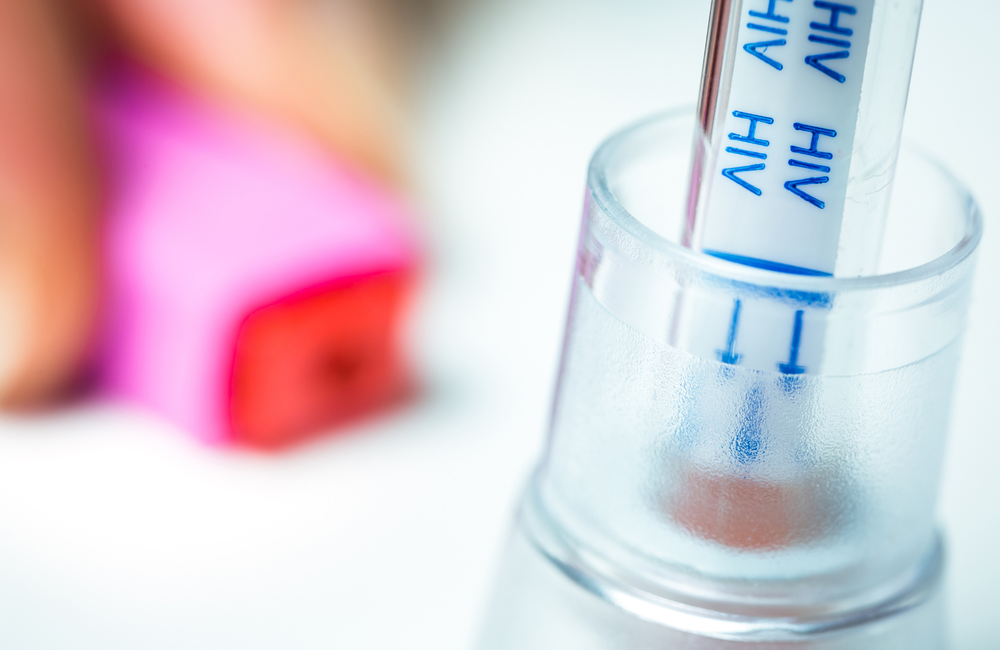
Key points
- Tests always produce a small number of false positive results.
- In settings where very few people have HIV, a higher proportion of reactive results will be false positives.
- To ensure accurate diagnosis, a sequence of confirmatory tests is used to verify all reactive results.
- A diagnosis of HIV is never made on the basis of a single test result.
The ideal HIV screening test would correctly identify all HIV-positive and HIV-negative individuals 100% of the time. While many HIV tests are extremely accurate, they do not achieve 100% accuracy.
A false positive is a test result that says a person has HIV when, in fact, they do not have it. Because it is upsetting and disturbing to receive a false positive result, preliminary positive (‘reactive’) results must always be verified with a series of confirmatory tests.
What causes false positive results?
HIV tests are based on the detection of antibodies to HIV. These are proteins produced by the immune system in response to a foreign substance, such as HIV. The main cause of false positive results is that the test has detected antibodies, but they are not antibodies to HIV – they are antibodies to another substance or infection. Tests are not meant to react to other types of antibodies, but it sometimes happens.
There are other reasons why a test may give a false positive result. Depending on the testing device, reading the test result may rely on subjective interpretation. When the result is borderline, experienced staff give more consistently accurate results. A false positive result could also be the result of a sample being mislabelled, mixed up with another person’s, or some other clerical or technical error.
Less commonly, false positive results may occur in people who have recently had a vaccination or have an autoimmune disease (such as lupus).
Reactive results and follow-up testing
Because of the possibility that a positive result from a single test is, in fact, a false positive, most healthcare professionals prefer to talk about the result being 'reactive' rather than 'positive'. If the result is reactive, this indicates that the test has reacted to something in your blood and needs to be investigated further.
This preliminary result must be verified with a series of confirmatory tests. If the initial test was done on a rapid, point-of-care test, you might do a follow-up test with a second rapid test that works in a slightly different way. If you provided a blood sample for analysis in a laboratory, the staff there will run several tests on the sample before telling you the result.
My test result is reactive. What’s the chance that this is a false positive?
If you tested in a healthcare facility, the staff there should make sure you have the necessary follow-up tests. This sequence of confirmatory tests is carefully planned to prevent inaccurate results from being given. Healthcare professionals call it a testing algorithm. If you have been tested in this way, with a sequence of confirmatory tests, and you have been told that you are HIV positive, you can be confident of the result. The rest of the information on this page does not apply to you.
On the other hand, you might have been tested with a rapid, point-of-care test at a location where the staff could not do the confirmatory tests immediately. If your initial result was reactive, the staff may have asked you to come back on another day or to go to another healthcare facility for the follow-up testing. Or you might have taken the test yourself, using a device for self-testing or home testing.
"An HIV diagnosis is never made on the basis of a single test result."
If that is the case, the confirmatory testing is essential. There is a possibility that your reactive result is in fact a false positive. The only way to know is to go and have it checked by a qualified healthcare professional.
The accuracy of a single HIV test depends in part on characteristics known as sensitivity and specificity. Sensitivity is an indication of test performance when testing people who do have HIV, whereas specificity reflects test performance in relation to people who do not have HIV. Many modern HIV testing devices are extremely sensitive (over 99%) and extremely specific (over 99%). There’s more information on sensitivity and specificity on another page.
The chances of having a false positive also depend on how common HIV is in your community. False positive results are quite a rare event, but in a community where very few people have HIV, true positive results are even rarer. In a setting where HIV is more common, a reactive result is less likely to be a false positive.
For example, take a test with 99.5% sensitivity and 99.5% specificity. If this test is used in a setting where 0.2% of people have HIV (for example, among the general population in the UK), the probability of a reactive result being correct is 28.5%. The number of people given an incorrect reactive result (71.5%) is greater than the number given a correct result (28.5%).
In contrast, if the same test is used in a setting where 8% of people have HIV (for example, among gay and bisexual men in the UK), the probability of a reactive result being correct is 94.5%. There are far fewer false positives (5.5%), but they still occur.
The figures describing the probability of a reactive result being ‘true’ are known to healthcare workers as the ‘positive predictive value’. Some more examples, all based on a test with 99.5% sensitivity and 99.5% specificity, are given below.
|
Prevalence of HIV |
Examples of settings with this prevalence of HIV |
Probability that a reactive test result reflects a true HIV infection (positive predictive value) |
|---|---|---|
|
0.1% |
General population in Australia |
16.6% |
|
0.2% |
General population in the UK, Sweden or India |
28.5% |
|
1.4% |
African Americans in the US |
73.8% |
|
5% |
General population in Kenya; female sex workers in Brazil |
91.2% |
|
8% |
Men who have sex with men (MSM) in the UK |
94.5% |
|
18% |
General population in South Africa; MSM in Malawi |
97.7% |
|
30% |
General population in KwaZulu-Natal, South Africa; MSM in Bangkok, Thailand; female sex workers in Kenya |
98.8% |
To put this in individual terms:
- If your behaviour is unlikely to put you at risk for HIV and you live in a community in which HIV infection is quite uncommon, and you have received a reactive result with a single test, this result should be interpreted with caution. In these circumstances, a reactive result is much more likely to be a ‘false positive’ than to reflect a real HIV infection.
- If you come from a community with a higher prevalence of HIV or if the sex you have been having puts you at greater risk of HIV, there is a greater possibility that the result is accurate.
For these reasons, an HIV diagnosis is never made on the basis of a single test result. All reactive (potentially positive) results are checked with extra confirmatory tests.
The positive predictive value of a testing algorithm, using a sequence of two or three different tests, is almost 100%. If a positive result has been confirmed in this way, you can be confident that it is accurate.
Find out more about the accuracy of HIV testing
For more information about HIV test accuracy, read our pages on sensitivity and specificity and on window periods. Our research briefings contain detailed information about the accuracy of fourth-generation combination tests, rapid point-of-care tests and self tests.