
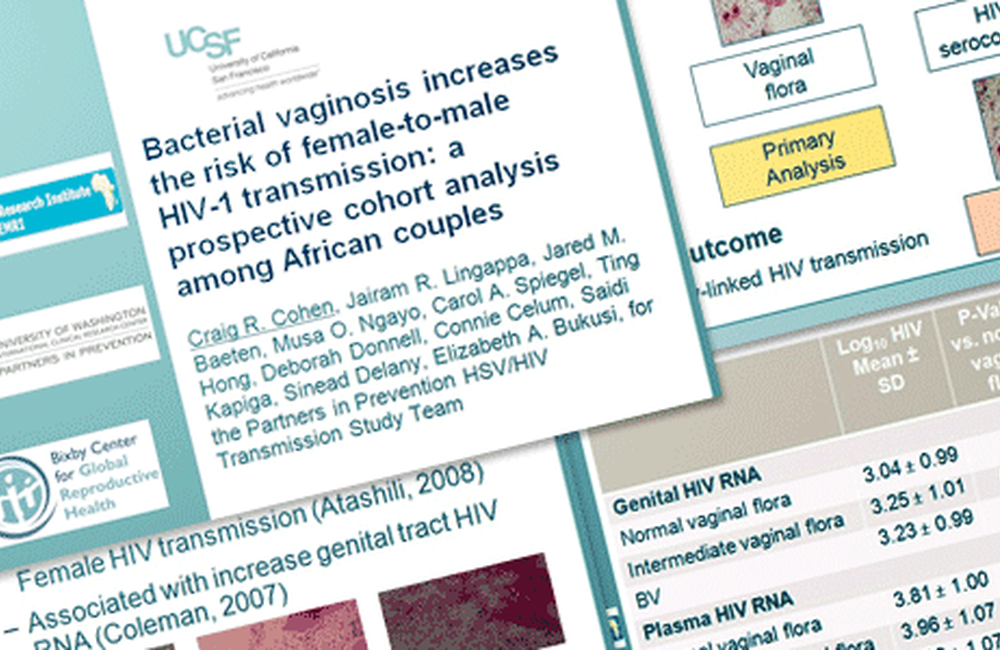
A man who is in a relationship with an HIV-positive woman has a three times higher risk of acquiring HIV if his partner also has bacterial vaginosis, Craig Cohen told the Sixth International AIDS Society conference (IAS 2011) in Rome today. Whereas it has been previously established that bacterial vaginosis increases a woman’s risk of acquiring HIV, this is the first time that it has been shown to increase her risk of transmission to sexual partners.
Bacterial vaginosis (BV) is a condition which occurs when the normal balance of bacteria in the vagina becomes disrupted. This can result in an over-growth of certain bacteria (flora), which may be accompanied by symptoms such as discharge, itching and pain. It can sometimes cause pelvic inflammatory disease and lead to problems with fertility and childbirth.
A number of prospective studies have established that having BV is associated – for women – with an increased risk of acquiring HIV. Studies on men’s risk of acquiring HIV when their sexual partners have bacterial vaginosis have not previously been conducted.
However, some studies have shown that BV is associated with an increase of HIV viral load in the genital tract. There is also evidence that HIV-positive women who have bacterial vaginosis when they give birth are at greater risk of passing HIV on to their child.
Craig Cohen presented an analysis of data on couples recruited to the Partners in Prevention study, conducted in seven countries of southern and eastern Africa. There were 2236 HIV-negative men in the cohort who had an HIV-positive female partner. Both partners were followed for up to two years.
Couples had been together for a median of five years and three-quarters were married. A third reported having unprotected sex, although condoms and counselling were provided by the researchers. The HIV-positive partner had to have a CD4 cell count above 250 cells/mm3 and not be on HIV treatment at the start of the study.
Across over 10,000 study visits at which vaginal flora was assessed, 34.9% of women had bacterial vaginosis, 22.8% had intermediate flora and 42.8% had normal flora.
During the course of the study, 57 of the men became HIV positive when HIV genotyping (env and gag) could confirm that they had similar virus to that of their partner. In other words, they probably hadn’t acquired HIV outside the primary relationship.
The investigators then identified the measurement of vaginal flora for their partner that was taken closest to the estimated date of seroconversion (no more than three months previously). This data was missing for seven women, leaving 50 couples in the analysis.
Nine HIV transmissions originated from women with normal flora, ten from women with intermediate flora and 31 from women with bacterial vaginosis.
After controlling for a large number of potentially confounding factors (sociodemographic, behavioural and biological), men whose partners had BV had a three times higher risk of acquiring HIV than other men (hazard ratio 3.06, 95% confidence interval 1.35 – 6.95).
Women with BV did have higher genital viral loads (3.23 log, compared to 3.04 log in women with normal flora). This was statistically significant, but Cohen suggested that it probably isn’t clinically significant.
He advanced two other hypotheses that could explain the increased risk to male partners. Firstly, that normal bacteria may be virucidial against HIV, reducing the proportion of virus that is infectious. Secondly, that bacterial vaginosis could indirectly increase the male partner’s susceptibility to HIV. Cohen noted that long-term sexual partners share genital flora, with men acquiring bacteria from their partners. It is possible, he suggested, that bacteria may activate Langerhans cells and CD4+ T-cells, making the man more susceptible to HIV infection.
A significant challenge in acting on this research is that current treatment strategies for bacterial vaginosis are inadequate, with low cure rates and the problem often recurring.
Cohen CR et al. Association of bacterial vaginosis with female-to-male HIV-1 transmission among HIV-1 discordant couples in Sub-Saharan Africa. Sixth International AIDS Society conference, Rome, abstract MOAC0202, 2011.
View abstract MOAC0202 on the conference website
View the slides from Craig Cohen's presentation, with audio, on the conference website