
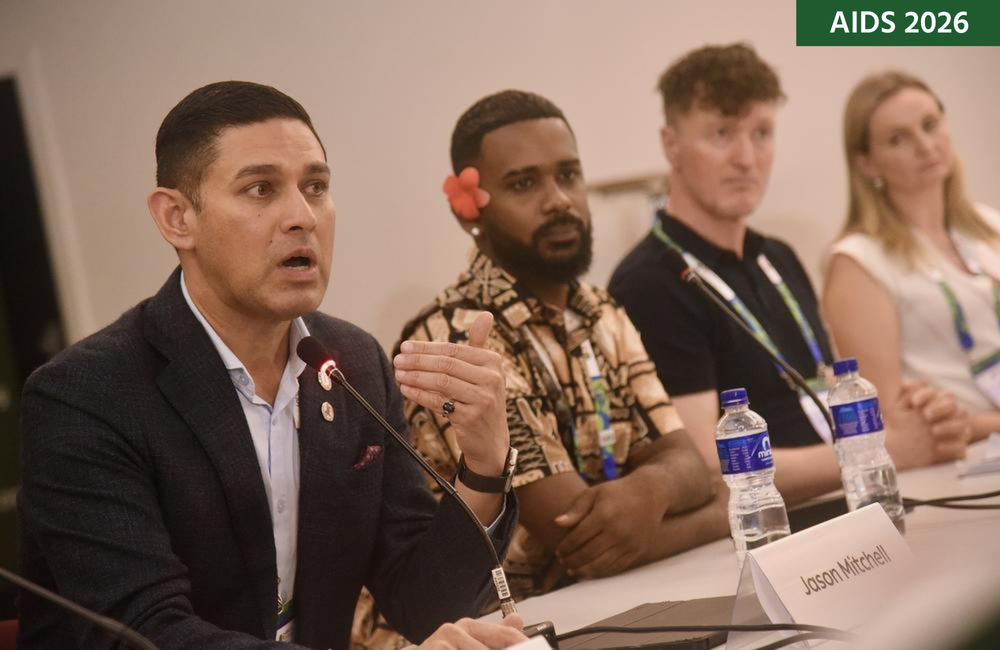
Fiji – a country that would not have been on the agenda at a major HIV conference a decade ago – is now home to the world’s fastest growing HIV epidemic, driven mainly by people injecting methamphetamine (meth).
“It’s important to talk about what’s happening in Fiji, as it can happen anywhere in the world,” said Dr Jason Mitchell, the head of Fiji’s National HIV Outbreak Cluster Response Task Force at the Ministry of Health and Medical Services.
And what is happening in Fiji is dire: in a country of under a million people, a 1.6% HIV prevalence among adults means that roughly 1 in every 60 adults has HIV. Of the approximately 9000 people living with HIV in the country, just over 2000 of them were diagnosed in 2025 alone – a staggering 27% increase from 2024. While the rest of the world is accelerating towards UNAIDS’ 2030 targets, Fiji is projected to triple yearly infections by 2030. One child is born with HIV every week, while one dies of AIDS-related complications every month.
These data were shared at the 26th International AIDS Conference (AIDS 2026) being held in Rio, Brazil this week.
A culture of sharing impacting HIV transmission
Mitchell pointed out that sharing is a central part of Fijian culture. He gave the example of a ceremonial root, kava, that is shared during traditional ceremonies: “The practice of consuming kava is you have one mixing bowl and one receptacle or glass that we all share. The practice of kava has spilt over into our consumption of alcohol.” Unfortunately, this cultural practice has likely also influenced needle sharing for using meth – a common practice, even among families.
“People start by injecting, instead of smoking or snorting,” Mitchell also said. This is another factor that differentiates Fiji’s meth epidemic. Often drugs are mixed with blood instead of water and then injected – this practice is called koda in Fiji.
Tracking Fiji’s epidemic
Fiji’s HIV outbreak was only declared in early 2025. There has been an over 30-fold increase in new HIV diagnoses since 2010. Sharing of injecting equipment has been a key factor in Fiji’s epidemic, with people who inject drugs emerging as a clear key population requiring attention and resources – they have an astonishing HIV prevalence rate of around 64%. However, as Mitchell noted, “the epidemic is now spilling over into every other population group in the country.” At an overall prevalence over 1%, Fiji now has a generalised HIV epidemic.
While more men are impacted, accounting for around two-thirds of new diagnoses in 2025, the ratio between men and women is beginning to narrow. Despite transgender people only making up a small number of people living with HIV in total, prevalence in this group is second only to people who inject drugs, at around 28%. Unlike almost every other place in the world, vertical transmission is exceedingly high, at 18%.
Research presented at AIDS 2026 by Dr Dashika Balak, also from Fiji’s Ministry of Health and Medical Services, used molecular surveillance to better understand transmission networks and detect any emerging antiretroviral therapy (ART) resistance. This technique combines genetic sequencing with drug resistance testing to track linked infections, providing a clearer picture of transmission networks.
Between early 2024 and 2025, a sample of 278 mostly newly diagnosed people participated in the study. Researchers collected dried blood spot samples for both phylogenetic and drug resistance analysis. The average age of participants was 30, they were mostly iTaukei (Indigenous Fijians, 94%), men (79%) and people who inject drugs (54%). Unlike other epidemics, Fiji only has a much smaller percentage of gay and bisexual men impacted by HIV – only 2% in this study.
Integrase strand transfer inhibitor-based regimens, such as those containing dolutegravir, were introduced in Fiji in late 2023. As these are widely used first-line ART regimens globally, any emergent resistance would be a cause for concern. In this study, there was only one instance of dolutegravir resistance noted in a man who was newly diagnosed and had not been on treatment before.
One of the current challenges in Fiji is that of the 40% who have HIV and know their status, only 56% are on treatment. Even more concerning: only 15% of those on treatment are virally suppressed. This equates to a shocking 3.2% of all people with HIV in the country having an undetectable viral load.
In terms of phylogenetic sequencing, three main clusters were found. In each cluster, all the cases of HIV are linked to a common source – this typically gives some insight into the mode of transmission. For clusters 1 and 3, comprising of 63 and 21 people respectively, injecting drug use was identified as the main mode of transmission. In cluster 2, comprising 22 cases, the pattern of transmission was linked to gay and bisexual men. However, as Balak pointed out, many of these men also inject drugs.
Desperate need for resources and syringe service programmes
Balak said that it was “a matter of national urgency” to reintroduce low-cost sterile needles and syringes to pharmacies and create a national needle and syringe programme.
Mitchell explained that Fiji does not have a needle and syringe programme, and that police have targeted pharmacies selling needles and syringes. There is outreach to communities, but this is limited. Unfortunately, HIV has become associated with unlawful drug use practices, exacerbating stigma and discrimination. Thus, despite political will, introducing comprehensive harm reduction will require overcoming multiple social barriers.
Mitchell also noted that the country often runs out of both HIV testing kits and ART medications. The country’s Global Fund support currently comes through a Western Pacific multi-country grant covering 2024-2026, but the future of this assistance is unclear. They have strong partnerships with Australia, New Zealand and some Asian countries, but will need ongoing funding to make a realistic dent in their rising numbers.
Mitchell made a plea for continued funding to ensure an upscaled response. He also emphasised that this epidemic could impact other Pacific islands too, as many students from neighbouring countries spend time in Fiji.
“Perhaps the greatest crime and shame of all is that this is all preventable,” he said.
Balak DA. Molecular HIV Surveillance During Fiji’s HIV Epidemic. 26th International AIDS Conference, Rio de Janeiro, abstract OAC0206LB, 2026.
View the abstract on the conference website.
Mitchell J. Fiji: The World’s Fastest Growing HIV Epidemic. 26th International AIDS Conference, Rio de Janeiro, media roundtable, 2026.