
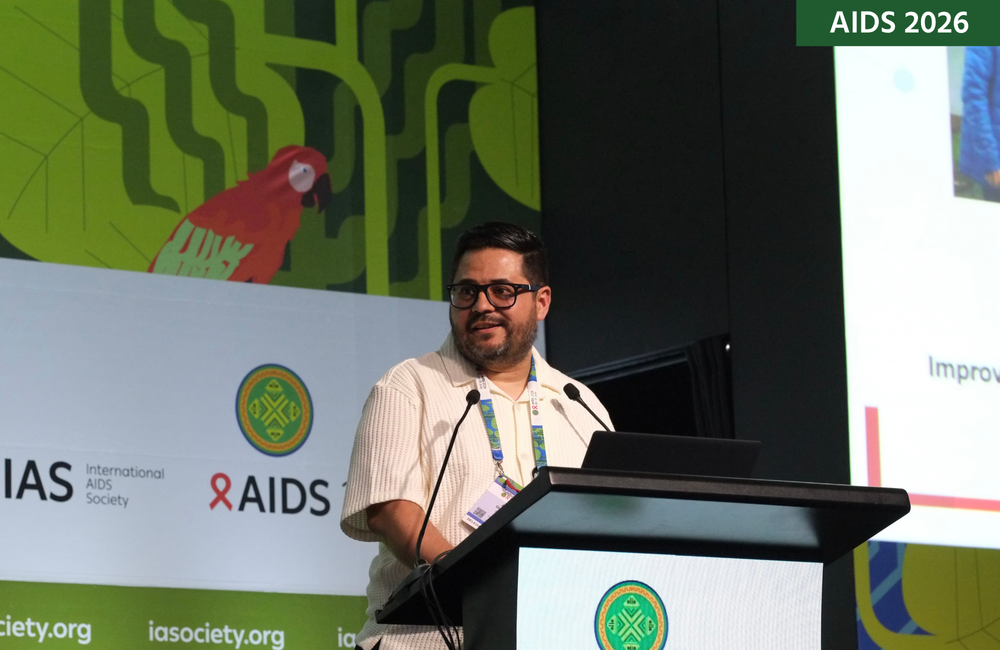
Nearly 7% of a large group of Venezuelan migrants in Colombia tested positive for HIV, according to a presentation by José Guillen from Red Somos at the recent 26th International AIDS Conference (AIDS 2026) held in Rio de Janeiro. Most were linked to treatment and were able to achieve viral suppression, despite administrative and legal barriers.
Maintaining health services for this large migrant population has been a formidable challenge – one that community-based organisations such as Red Somos have tackled head on. Guillen shared more information on some of the challenges and successes of their community-based model, “Tu pana te cuida” (Your buddy takes care of you), at the conference.
“This isn't just a programme that was built for the migrant population – it was built together with them,” Guillen emphasised.
Migration barriers to HIV care
There are currently 2.8 million Venezuelan migrants living in Colombia – a displacement second only to Sudan globally. Guillen explained that Venezuelans have been forced to leave their country due to a lack of access to healthcare, food insecurity, rights violations and political persecution. Around 600,000 of these migrants are undocumented – making it much harder to access the Colombian healthcare system, including testing for HIV and getting antiretroviral therapy (ART). Migrants who do not have a visa or a permit can only access emergency services, not care for chronic conditions such as HIV.
Guillen described their community-based model. “The goal isn't only to diagnose people, but to accompany them through the entire care process,” he said. “The model starts with community-based screening, peer navigation, psychosocial support, legal guidance, and support with migratory regularisation. Once people are regularised, they're referred into the health system. But while that's happening, we still provide care: we give them antiretroviral medication, and they achieve viral load suppression.”
‘Regularisation’ refers to the process of getting documents that accurately reflect migration status – and ones that allow access to the healthcare system. Despite Colombia having introduced a Temporary Protection Status for Venezuelan Migrants (ETPMV) in 2021 to assist with this process and to help regularise millions, this can still be a fraught process that is challenging to navigate without knowledge and assistance.
Partner notification key to success
Between January 2024 and December 2025, Tu pana te cuida was implemented across three Colombian cities – Bogotá, Soacha, and Barranquilla – with 7,631 people served. Most were men (60%), 40% identified as LGBTQ, and 70% were undocumented, with many facing economic instability, discrimination, mental health challenges and a lack of awareness of their rights.
In total, 503 people were diagnosed with HIV, a positivity rate of 6.6%. This is much higher than the roughly 1% HIV prevalence rate found in prior research. Of those diagnosed, most were men (65%), with 35% being gay men. Smaller numbers were transgender (5%) and engaged in sex work (5%). Beyond diagnosing HIV, the programme was able to link 96% of those diagnosed to care and treatment. Within six months around 94% of those on treatment had achieved viral suppression. Among those who were undocumented, about 80% achieved migratory regularisation.
One of the most effective strategies was assisted partner notification. Guillen shared that of 508 sexual partners tested, there were an additional 130 diagnoses – a positivity rate of 25.6% – four times higher than the community-level testing positivity rate at 6.6%.
“Assisted partner notification was a key innovative strategy in achieving these results. But so was a rights-based strategy built with organised communities, co-ordinated work with other organisations, differentiated care, providing health services directly and free of charge to migrants in irregular status, while also offering psychosocial support and legal assistance,” Guillen said, explaining the comprehensive nature of this programme.
“Community-based organisations can significantly improve health outcomes for migrants living with HIV,” he concluded. “Migratory regularisation should also be understood as a public health intervention, because it facilitates access to care and ensures continuity of antiretroviral treatment. Finally, we need to protect human rights, eliminate structural barriers, and recognise that community organisations are strategic allies of health systems. Our experience shows that migrants are not the ones who fail when facing health systems – very often, it's the health system that fails to meet their needs.”
Guillen Cañizares JR. Improving the HIV care cascade among Venezuelan migrants in Colombia through a rights-based model, community-based testing and assisted partner notification. 26th International AIDS Conference, Rio de Janeiro, abstract OAE1603, 2026.
View the abstract on the conference website.
(Guillen’s presentation was translated from Spanish.)