Skip to content

This illustrated leaflet gives basic information on very recent HIV infection.

During the first few weeks after becoming infected with HIV, your body's immune system is working out what HIV is and how to get it under control.

You may feel unwell for a short time (this is called seroconversion illness). Even if you don't take HIV treatment, after a few months, your immune system will be better at keeping HIV under control.

It’s recommended to start HIV treatment as soon as you feel ready. Treatment will protect your health and prevent transmission (passing HIV on).

Download the leaflet

528.34KB
Very recent infection
Roger Pebody

Roger Pebody

Commissioning Editor

Roger joined aidsmap in 2008 and was Managing Editor from 2018 to 2024. As a freelancer, he now edits aidsmap’s news and conference coverage, as well as working on updates to About HIV pages. He is also a contributing science editor for TheBodyPro, a freelance journalist for The Lancet HIV, and a medical writer helping researchers prepare articles for peer-reviewed journals. He began working on HIV at Gay Men Fighting AIDS in the mid-1990s.

Basic information

Better off knowing

Better off knowing

Testing

Testing basics leaflet.

How do I know if I have HIV?

A person wearing a surgical glove holds the hand of somebody else. This person is having their finger pricked with a fine needle. The needle has drawn a small amount of blood which is visible. The image has a pink and purple filter over it.

Where can I get an HIV test?

A person having a blood test. They are sitting in a chair while a nurse collects blood in a vial.

What are the symptoms of HIV?

Domizia Salusest | www.domiziasalusest.com

What is the difference between HIV and AIDS?

Illustration of HIV virus.

Myths and facts

Myths and facts

What does ‘reactive’ mean when testing for HIV?

A close-up of a glass receptacle which contains a testing vial. This vial is labelled as being ready to receive blood for an HIV test. The image has a pink and purple filter over it. The image has a pink and purple filter over it.

What does ‘non-reactive’ mean when testing for HIV?

A close-up image of somebody holding an HIV test between two of their fingers. The test has not been taken yet and is blank. The person is wearing blue surgical gloves. The image has a pink and purple filter over it.

What does ‘indeterminate’ mean when testing for HIV?

Mareike Günsche | www.aspect-us.com

What is p24 antigen?

A close-up of somebody's hand in a blue surgical glove holding a vial of blood hand.

CD4 and viral load

CD4 and viral load

HIV testing

A close-up of a glass receptacle which contains a testing vial. This vial is labelled as being ready to receive blood for an HIV test. The image has a pink and purple filter over it. The image has a pink and purple filter over it.

Home HIV testing (self-testing and self-sampling)

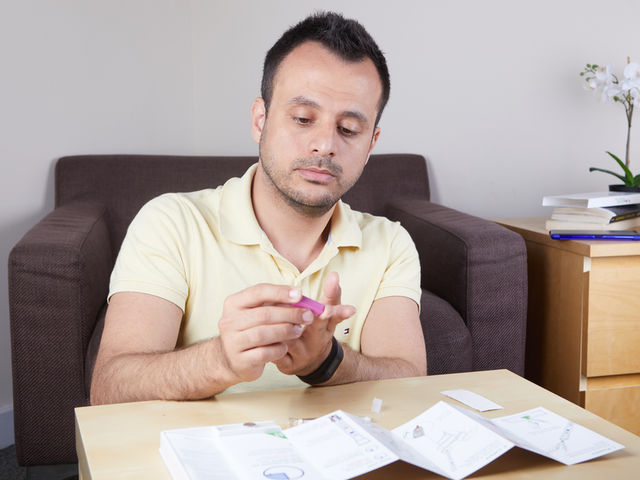
A man pricks his finger so that he can test himself for HIV. In front of him are the instructions for the test. He is concentrating on pricking his finger. The image has a pink and purple filter over it.

HIV testing for trans and non-binary people

Mareike Günsche | www.aspect-us.com

Early HIV infection

A woman site on the sofa with a blanket over her and around her shoulders.

What are the symptoms of early HIV infection?

A woman is resting in bed.

CD4 cell counts

A vial of blood is resting on a form that indicates it will be tested for CD4 cells. The image has a pink and purple filter over it.

Viral load

A close up of a person's arm while they are having their blood taken. The person taking the blood is wearing surgical gloves. We can see some of the blood is already in the tube.