
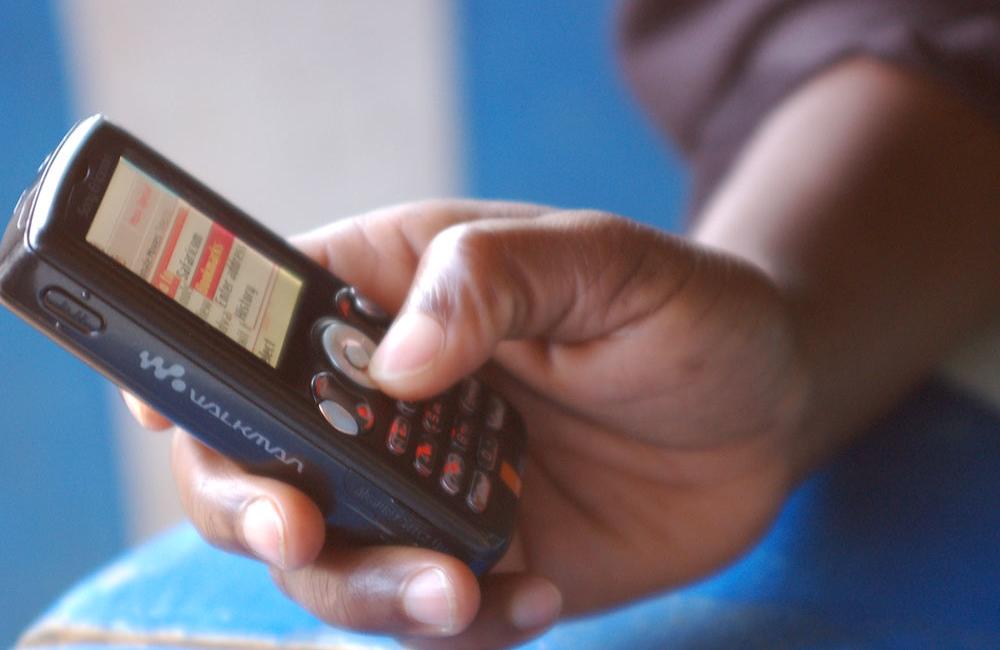
A text message from a clinic each week resulted in better adherence and a higher level of viral load suppression among people with HIV after starting antiretroviral treatment in Kenya, a randomised controlled trial has shown.
The results were published in the Online First section of The Lancet this week. The trial was sponsored by the US President’s Emergency Plan for AIDS Relief (PEPFAR).
The intervention cost around 20 cents per patient each month, and would potentially allow one nurse to monitor adherence and other issues in 1000 patients each month, the researchers calculated.
Mobile phones are emerging as a new tool in health care. In sub-Saharan Africa mobile phone networks have expanded to cover much of the continent, and phone ownership is growing exponentially.
The Kenyan study is the first randomised study to test whether sending a reminder message sent to patients taking antiretroviral drugs in sub-Saharan Africa not only improves adherence, but also has a long-term effect on responses to treatment.
The study was conducted at two clinics in Nairobi (one serving a very low income area and one a more prosperous district) and at one clinic in a rural district.
It recruited patients starting ART for the first time who owned a mobile phone (88%) or who had access to a shared phone (12%). Patients paid for their own air time and text messages.
The study recruited 538 participants eligible for antiretroviral therapy under Kenyan national guidelines in 2007 and 2008, and participants were randomised either to the text message group (n=273) or the standard care group (n=265).
Patients received structured adherence counselling prior to starting treatment, and those in the message group were told to report if they had any problems with adherence in responses to their weekly text message from the clinic.
Typically, the slogan "Mambo?" was sent, which is Kiswahili for "How are you?" The health workers used multiple recipient (bulk) messaging functions to improve efficiency. Patients in the intervention group were instructed to respond within 48 hours that either they were doing well ("Sawa") or that they had a problem ("Shida"). The clinician then called patients who said they had a problem or who failed to respond within two days.
The primary outcomes measured in this study were self-reported ART adherence (>95% of prescribed doses in the past 30 days at both 6- and 12-month follow-up visits) and viral load suppression below 400 copies/ml at 12 months.
During the study 114 patients dropped out, including 44 patients lost to follow-up and 55 who died. There was no significant difference in loss-to-follow-up rates between the two groups.
Intent to treat analysis, which evaluated outcomes in everyone recruited to the study, with lost patients counted as failures, showed that optimal adherence to ART was reported in 168 of 273 (62%) patients receiving the message intervention compared with 132 of 265 (50%) in the control group. Suppressed viral loads were reported in 156 of 273 patients (57%) in the message group and 128 of 265 (48%) in the control group.
On treatment analysis, which counted only those who remained in the study until the end, showed no significant difference in adherence (91%) but a significantly higher rate of viral suppression in the message group (75 vs 66%, p=0.047).
After adjustment for baseline factors such as age, CD4 count, gender, literacy and income, adherence in the message group remained significantly better (odds ratio 0.57, 95% confidence interval 0.40 to 0.83, p=0.0028). The relationship between message receipt and viral load suppression was less strong in the adjusted analysis, and was on the borderline of statistical significance (odds ratio 0.70, CI 0.50 to 1.01, p=0.058).
Overall, an average of 3.3% of patients sent messages indicating that they needed help each week, and this proportion declined from 6% in the first three months to 2% afterwards (p<0.0001).
No breaches of confidentiality as a result of text messaging occurred during the study, and patients were highly satisfied with the service. 98% said they would recommend it to a friend, and all but three patients receiving the service at the end of the study said they wanted it to continue. Many patients said they valued the service because they felt “like someone cares”.
The study had a very low impact on healthcare staff; it required no advance training to deliver the service, and the researchers estimated that one nurse could manage 1000 patients and expect to call only 33 patients each week.
The researchers say that one extra patient would achieve adherence for every nine patients using the SMS service; while one extra person would achieve viral suppression for every 12 treated in the SMS group.
In conclusion, say the authors, the study has a number of important implications.
It is the first to show that an adherence intervention has an effect on virological failure rates, and it is a very low-cost intervention. If it was applied to everyone receiving ART in Kenya through PEPFAR funding (297,000 in 2009), they calculate, it would result in an additional 26,354 people with suppressed viral load.
The authors also note that increasing viral suppression in the population is likely to have a knock-on benefit for HIV prevention.
In an accompanying editorial comment, Jeffrey Stringer and Benjamin Chi of the Centre for Infectious Disease Research in Zambia say that policy makers should now consider bringing the intervention to scale, but say a number of questions still need to investigated before copying the intervention.
At the moment, they say, it’s not clear how the once-weekly message affected adherence. Also, it’s not clear how it would work in other countries, particularly where fewer people own phones. Would it be necessary to provide phones or subsidise airtime?
They also say think that cost-effectiveness needs to be studied, since if it was applied across the whole national treatment programme in Kenya, it would take up 1% of the current budget at a cost of around $2.6 million. But this might be cost-effective given the cost of second-line treatment, they say.
Lester RT et al. Effects of a mobile phone short messaging service on antiretroviral treatment adherence in Kenya (WelTel Kenya1): a randomised trial. The Lancet, advance online publication, November 9, 2010.